Home / Journal / Choosing an Engagement Ring Setting
May 23, 2026
How to Choose an Engagement Ring Setting: A Guide to the Lihara Rings
The diamond gets most of the attention, but the setting is what you actually live with. It decides how the stone sits, how it catches light, whether it snags on a sweater, and whether the ring still feels like you in ten years. Here is how to think through the choice, style by style, using the rings in our collection as examples.
Start With How It Will Be Worn
Before you fall for a look, picture the ring on an ordinary Tuesday. A few honest questions narrow the field quickly:
- How active are your hands? A center stone held high in prongs looks spectacular but sits proud of the finger. Lower settings and rings with a band that hugs the stone are easier to live with if you work with your hands, train, or travel a lot.
- Will it sit next to a wedding band? Some settings leave room for a straight band to sit flush; others are designed with a matching band that follows their shape.
- Do you want the diamond to look larger, or purer? A halo of small diamonds makes the center read bigger. A solitaire keeps all the attention on one stone.
- Classic or distinctive? Clean, simple settings age the slowest. Organic and vintage-inspired designs feel more personal.
The Five Setting Styles
Every Lihara engagement ring falls into one or more of five styles. Many rings combine two, such as a nature-inspired design with side stones, so treat these as starting points rather than boxes.
Solitaire
One center stone, nothing competing with it. The solitaire is the most timeless choice and the easiest to pair with any wedding band later. The details are in the head (how many prongs, how high) and the band (plain, tapered, or set with small diamonds).
Look at the Rose-Cut Taper Solitaire, a rose-cut diamond in a tapered, high-polish band, or the Secret Marquise Solitaire, a marquise in a four-prong setting with a subtle row of diamonds hidden beneath the stone.
Shop solitaire engagement rings →
Halo
A halo is a ring of small diamonds set around the center stone, visible from the top. It adds sparkle, makes the center look noticeably larger, and gives a smaller diamond real presence on the hand. Because the halo frames the stone, its outline matters: it can follow the shape of the center or contrast with it.
The Elongated Pavé Halo has an elongated halo of graduated round diamonds on a tapered, sparkling band. The Polished Navette Halo surrounds a round rose-cut diamond with brilliant diamonds for a softer, vintage-leaning look.
Hidden Halo
A hidden halo puts that row of small diamonds underneath the center stone, on the basket that holds it. From the top, the ring reads as a clean solitaire. From the side, there is a flash of diamonds that only you and the people close to you will notice. It is one of the most popular modern details for exactly that reason.
The Diamond Basket Solitaire cradles an oval in a diamond-accented basket above a polished band, and comes in several styles to choose from. The Double Hidden Halo lifts its center stone in four prongs over two hidden halos.
Shop hidden halo engagement rings →
Side Stone
Side stone rings set additional diamonds beside the center: a classic three-stone, a five-stone row, or clusters of pear and round diamonds on each side. They add width and sparkle across the finger, and the side stones can change the whole character of the ring.
The Slender Three-Stone Ring refines the three-stone ring with a slender band and delicate pear-shaped diamonds. The Five-Stone Oval Ring flanks an oval center with smaller oval and round diamonds, and the Pear Cluster Ring clusters pear and round diamonds on each side of the center.
Shop side stone engagement rings →
Nature
Nature-inspired rings borrow from leaves, vines and petals: diamonds scattered like dew, bands that twist like branches, marquise and pear stones arranged like foliage. They feel personal and romantic, and they are the most distinctive rings in the collection.
The Diamond Leaf Weave Ring weaves a band of diamond leaves toward a brilliant center stone. The Marquise Petal Bloom sets a marquise center within openwork petals, and the Marquise Garland Ring surrounds an oval with marquise, pear and round diamonds.
Shop nature-inspired engagement rings →
Choosing the Center Stone Shape
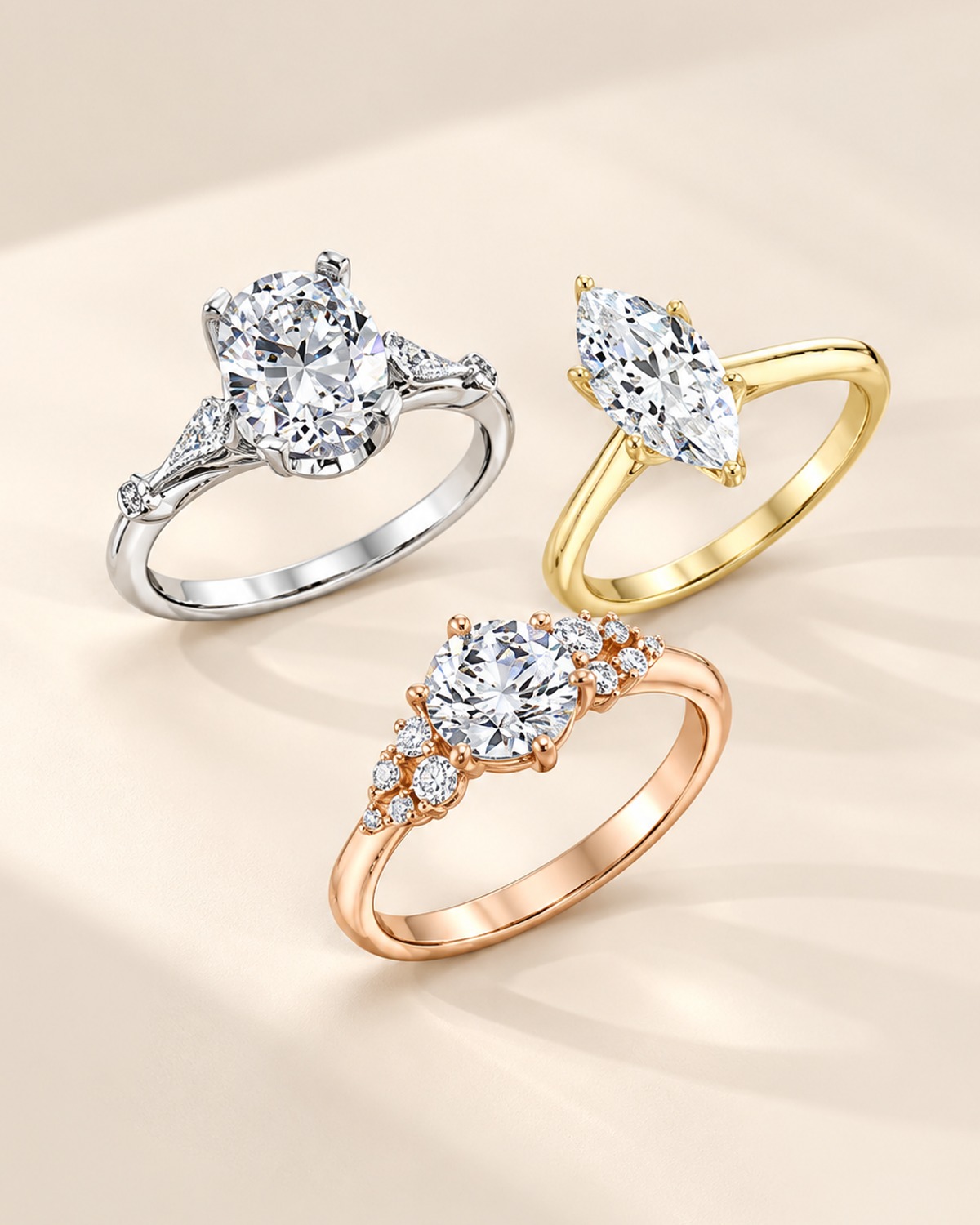
Each setting is made for specific center stone shapes and sizes, and its product page lists exactly which ones it takes. Across the collection you will find round, oval, pear, cushion, elongated cushion, emerald, radiant, princess, marquise, asscher and heart.
- Round is the brightest and most classic.
- Oval, pear and marquise are elongated shapes that make the finger look longer and the stone look larger for its carat weight.
- Emerald and asscher are step cuts: less sparkle, more clean flashes of light and a quiet, architectural look.
- Cushion, radiant and princess sit between the two, with brilliance in a softer or squarer outline.
Choose the shape first, then the setting that was made for it. A setting cut for an oval will not hold a round stone the same way, which is why our rings list their shapes and sizes rather than claiming to take everything.
Choosing the Metal
Every ring in the collection is offered in 14k white gold, 14k yellow gold, 14k rose gold and platinum.
- White gold and platinum make a diamond look as white as possible. Platinum is denser and heavier, and keeps its natural white color.
- Yellow gold is warm and classic, and pairs especially well with nature-inspired designs.
- Rose gold is soft and romantic, and flatters a wide range of skin tones.
Some designs, such as the Satin Leaf Crown and the Petal Vine Ring, can also be made two-tone, with their leaves or flowers in a second color of gold.
The Center Stone Itself
With the setting chosen, you pick the stone that goes in it: a lab-grown diamond, a natural diamond, or a gemstone. Every center stone comes with an IGI or GIA grading report, so you know its cut, color, clarity and carat weight before it is set.
You can also work the other way around and start with the diamond: browse lab-grown or natural diamonds first, then choose a setting that is made for it.
See It in 3D Before You Decide
Photos show one version of a ring. Our engagement ring pages also show the ring in 3D, built for the options you pick: change the metal, the center shape or the size, and the 3D view updates to match. Turn it, look at it from the side to see a hidden halo, and compare styles the way you would in a store.
If you have something in mind that is not in the collection, Lihara Studio lets you start from one of our settings, or build a solitaire or side stone ring from scratch, and send it to us. Within 2 business days you get renderings and a rough quote.
Don't Forget the Wedding Band
If you already know you will wear a band, choose the two together. Several of our rings, including the Milgrain Pear Crown, Floating Marquise Stream and Deco Bezel Solitaire, have a matching band designed to sit against them. Every matching band is in Wedding Bands.
Frequently Asked Questions
Which setting style is the most timeless?
A solitaire or a hidden halo. Both read as a single, clean stone from the top, which is why they rarely look dated.
Does a halo make the diamond look bigger?
Yes. The ring of small diamonds extends the outline of the center stone, so it reads as noticeably larger than its carat weight.
Can I choose a different metal from the one in the photos?
Yes. Every ring is offered in 14k white, yellow and rose gold and platinum, and the 3D view shows the ring in the metal you pick.
Does the center stone come with a grading report?
Yes. Every center stone comes with an IGI or GIA report.
Can I design something that is not in the collection?
Yes. Start in Lihara Studio and send us your design. You get renderings and a rough quote within 2 business days.
← Loose Diamonds vs. Preset: When to Buy the Stone First The Stone Got Easier. The Design Got Interesting. →